



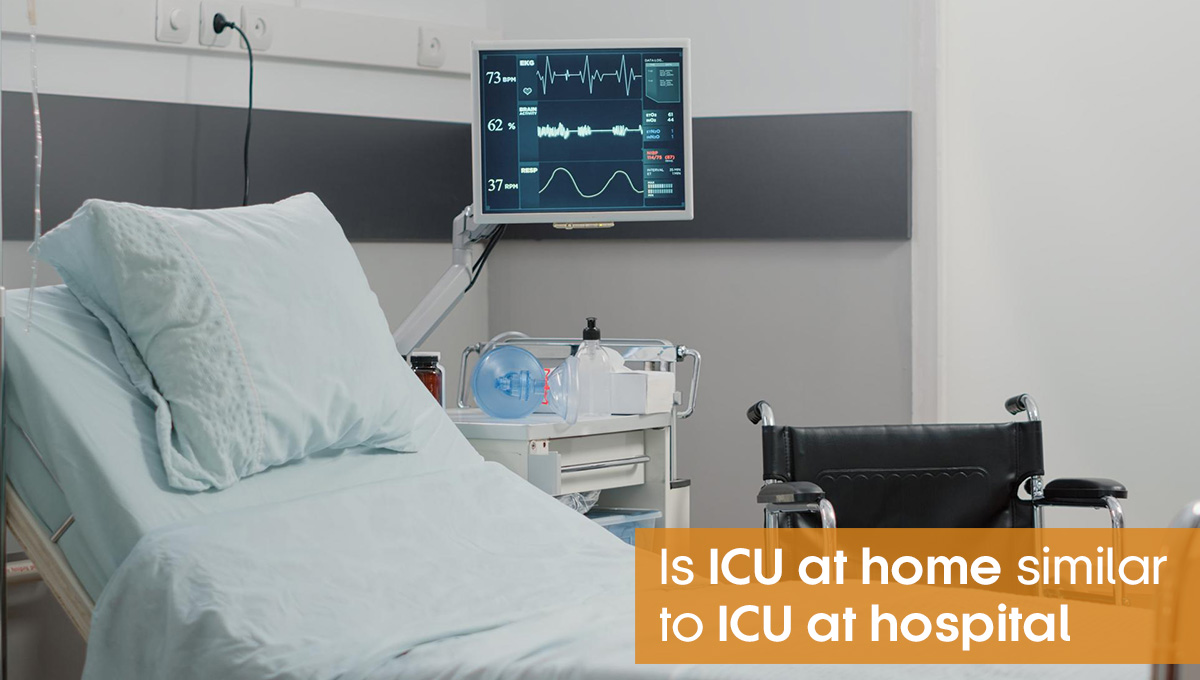
The answer to this question may not be as obvious as it appears. There are reasons why many people consider setting up an ICU at home for their loved ones. But the decision is not an easy one. With technological advancements in medical care, an ICU at home has emerged as a viable option compared to the hospital ICU, but the debate is on whether the set-up can truly offer the specialized care a person needs.
Let’s begin by understanding the key differences.
Understanding the differences between ICU at Home and Hospital ICU
Although the primary goal of both set-ups is to ensure that critical care is provided to patients, there may be a few inevitable differences and limitations that are present in each.
- Hospital ICUs are fully equipped with all the required specialized monitoring systems, ventilators, defibrillators, infusion pumps, dialysis apparatus, and other life-saving devices. These are important to handle all kinds of emergencies.
- The benefit of an ICU at home is that the set-up can be customized to the patient’s needs and requirements. It may include equipment such as oxygen concentrators, cardiac monitors, suction machines, and ventilators but there may be limitations when it comes to handling emergencies.
- At the hospital ICU patients’ families can be assured of 24/7 medical supervision. There is constant monitoring and immediate medical intervention by a team of on-duty doctors, specially trained nurses, and attendants. Nurses who specialize in critical care, and other facilities like telemedicine and remote monitoring can be made available at home for the patient to bridge the gap but the chances are that the intervention may not be as prompt as a hospital ICU.
- Hospitals house multiple patients with various health conditions and may expose patients who are admitted to different infections. However, they combat this with stringent measures to minimize the risk of hospital-acquired infections. ICUs at home may be safer but strict hygiene has to be taken to maintain a sterile environment. This calls for regular sanitization, adequate ventilation and high standards of cleanliness by the nurses, caregivers as well as family members.
- Patients at a home ICU receive personalized attention and one-on-one care with the added advantage of being in a familiar environment that offers a lot of comfort. Research has shown that patients recover faster when surrounded by loved ones as they experience lesser anxiety and emotional distress. At the hospital ICUs, nurses have to attend to many patients and may not be able to provide individualized attention all the time.
- If the patient requires critical care for a long time, the hospital ICUs can be expensive. The home ICU can be comparatively cost-effective for long-term care and may involve only the initial expenditure to rent out the necessary medical equipment and appointing a nurse or caregiver as required.
- The hospital ICUs are better equipped if the person requires any advanced diagnostic tools, surgeries and other invasive procedures if an emergency arises. This may not be the case with ICUs set-up at home. The time of intervention may depend on the availability of professionals and proximity of a hospital if the person is required to be shifted to the hospital for any specialized treatment or procedure.
Circling back to the pertinent question of whether an ICU at home is similar to the ICU at a hospital, based on the differences discussed above, the choice primarily depends on the condition, the requirement, and the duration and level of the treatment of a person along with what the family prefers. While an ICU at home offers personalized and loving care at home with reduced expenses, it cannot replace the hospital ICU which is better equipped with the devices and healthcare staff to handle emergencies and specific procedures. However, for stable critical care patients who require prolonged ICU support with specialized monitoring, trained nurses, and doctor supervision, a home ICU can be an effective, personalized, and affordable alternative.
Therefore you should choose an ICU at home only for the following:
- For patients with chronic illnesses who need long-term ventilator support and palliative care.
- Patients who require constant and intensive medical monitoring and care after surgery.
- Critically or terminally ill people especially elderly persons who are more comfortable with receiving treatment at home.
Hence before making any decision, it is vital to assess the patient’s condition with the doctor and ensure that the required medical equipment, trained medical personnel, and basic emergency protocols are available and can be comfortably used at home. The next important step is to consult a trusted home healthcare provider so that the transition from the hospital to home is smooth and seamless and the highest quality of care is given.